The Unseen Engine: How Women Are Driving the Pace
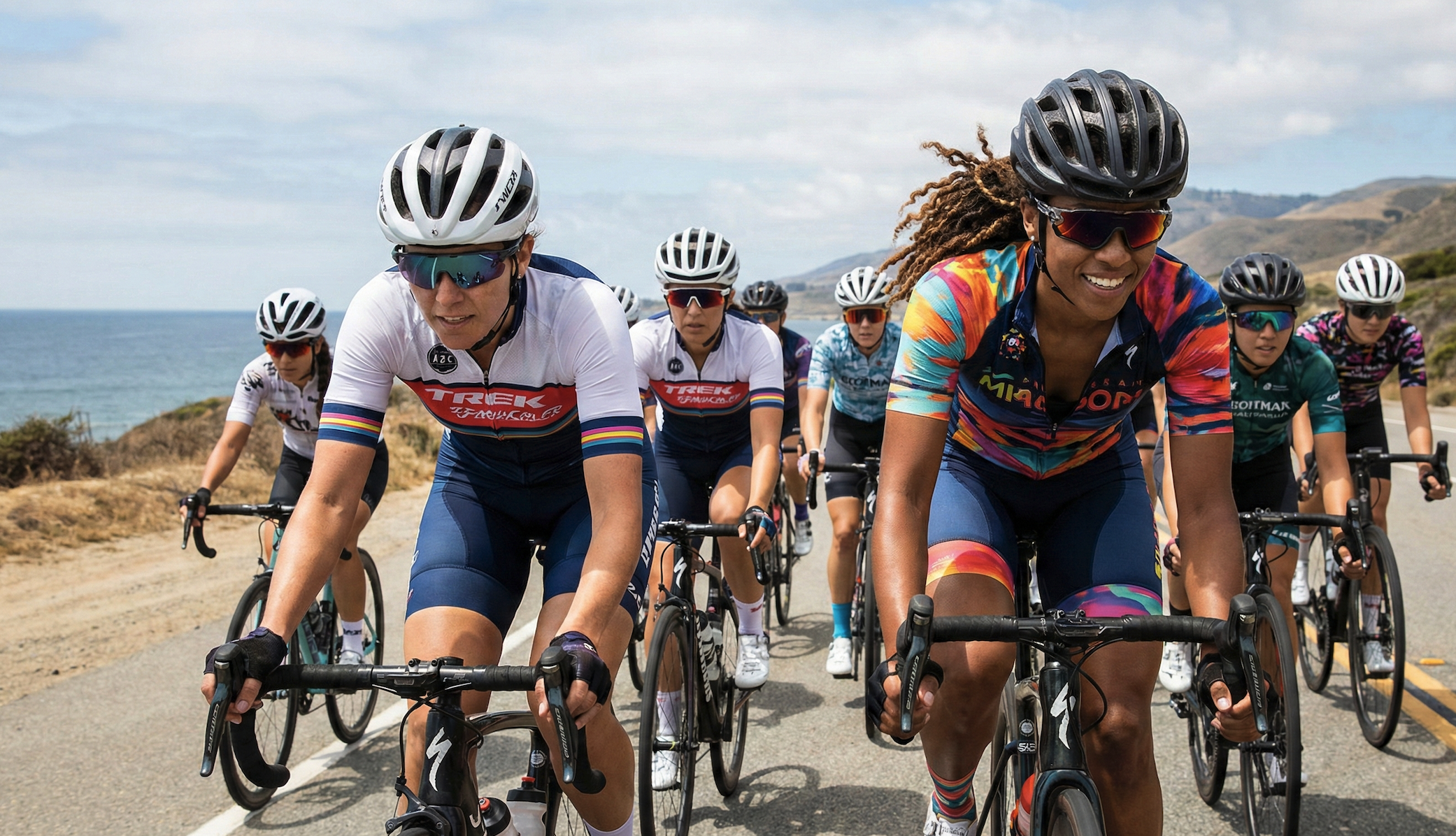
Women are leaders and the glue!
Category: Training / Culture
There is a specific sound in a fast group ride. It’s the collective hum of carbon wheels, the rhythmic ticking of freehubs, and the synchronized breathing of a pack moving at 18 mph.
Sometimes, in a mixed-gender group, there is another silent dynamic at play. It’s an assumption—often unconscious—that the female riders present are merely "hanging on," grateful for the draft provided by the men on the front.
If that’s what you think you’re seeing, you aren’t looking closely enough. You are missing the unseen engine.
Today’s female cyclist isn't just participating in the ride; she is often the glue holding the pace together. And that power wasn't built by accident. It’s the result of a quiet revolution in how women train, fuel, and ride.
The Myth of "Bulky" vs. The Reality of Horsepower For decades, endurance culture sold women a lie: that the goal was to be as light as possible. Resistance training was feared because muscle meant "bulk."
The modern female rider knows the physics: Power-to-weight ratio has two variables. You can lower the weight, or you can increase the power.
She chooses power.
She is in the squat rack in November when everyone else is taking time off. She understands that deadlifts don't make you slow; they build the posterior chain resilience needed to mash a big gear on a 15% gradient. Her consistency in the gym is the armor she wears on the road.
Fueling the Fire, Not Starving It The second revolution is on the plate. The unseen engine cannot run on fumes.
For too long, "diet culture" infiltrated sports nutrition, teaching women to shrink themselves. The powerful female rider rejects this. She knows you cannot fake glycogen stores at mile 80.
She doesn’t eat to be thin; she eats to perform. She understands that carbohydrates are not the enemy—they are rocket fuel. She respects her body enough to feed it what it requires to push past comfort zones repeatedly.
The Sisterhood of the Suffering There is a unique frequency shared between women in the peloton. It is a camaraderie born of shared experience—knowing what it takes to show up in a space that wasn't originally built for them.
This isn't the stereotypical "catty competition" the media likes to portray. It’s mutual elevation. It’s the nod between two women at a stoplight, an unspoken acknowledgment of the grit required to be there. When one woman gets stronger, the whole pack gets faster. They push each other past limits they wouldn't attempt alone.
The Quiet Kill All this training—the weights, the fuel, the consistency—culminates in a specific moment on the road.
It’s the moment the pace line rotates.
The old stereotype is that the female rider skips her turn at the front, sliding to the back to recover. But the unseen engine doesn't just draft.
She moves smoothly out of the slipstream into the wind. She doesn't surge to prove a point; she settles into her threshold zone and holds the speed steady. No drama, just watts.
There is a specific kind of silence that falls over a male rider when he realizes the wheel he's desperately trying to hold belongs to a woman who is calmly checking her bike computer. She isn't loudly announcing her presence. She’s just quietly dropping people.
The New Standard The power of women in cycling isn't about asking for permission to be in the group. It’s about doing the work—in the gym, in the kitchen, and on the road—so that when the crucial moment comes, they aren't just sitting on the wheel.
They are driving the pace.
